
Saugus City Directory Holdings
Saugus historical research starts with a shelf, not one seamless database. The Massachusetts State Library directory holdings verify an early 1874 item, a long but broken run from 1897 through the early twentieth century, selected later issues, and a 1997 local list. The catalog distinguishes ordinary directories from house guides. That distinction matters because a house guide may work from the address side, while an alphabetical book usually begins with a name. Gaps are real evidence too. A missing year should send a researcher to a nearby issue, a town report, or a local newspaper rather than invite a guess.
| Historical collection | Verified Saugus years | Repository | Reading route |
|---|---|---|---|
| Early and regular city-directory holdings | 1874; 1897-1898, 1899, 1902, 1904, 1906, 1908, 1910-1921; 1925 | Massachusetts State Library holdings | Confirm the volume and title page before using its conventions |
| House-guide issues | 1930-1931 through 1944 selected years; 1953-1956, 1962, 1965-1968, 1970, and 1975 | State Library holdings | Asterisk-marked volumes, useful for reverse-address work |
| Later local directory and list material | 1963, 1979, 1980, and 1997 | Saugus Public Library and State Library routes | Library reference, holdings request, or digitized 1997 scan |
| Separate voting lists | 1916, 1942, 1944, 1952, 1977, 1978, and 1980 | State Library holdings | Use as their own record series, not as a directory substitute |
The holdings record does not consistently identify a Saugus-specific publisher on every title page. A 1932 regional sample illustrates common directory fields, but it does not prove that every Saugus issue had the same publisher or abbreviations. Cite the volume actually used. The Saugus Public Library can help locate a volume through its reference service or interlibrary loan when a catalog entry points elsewhere.
Saugus City Directory Year Runs
The sequence has useful clusters. Issues from 1914-1915, 1916-1917, 1918-1919, and 1920-1921 allow close comparison around one household or street. The library and State Library record later gaps rather than a continuous annual run, so a change between two books is a time window, not a precise moving date. The separate voting-list years should also remain separate from the regular volumes. Each publication served a different purpose and may select people differently.
Begin with the year closest to the event already known. Record the title, date, repository, page or image, and whether the text is an image or OCR. Then move outward one available issue at a time. That simple method prevents a family story from becoming more certain than the printed evidence allows.
- Locate the nearest verified Saugus volume by year and identify its source type.
- Copy the name, address, and every printed abbreviation exactly as shown.
- Check the next available issue forward and backward, allowing for gaps in the run.
- Use a street or house-guide portion only after checking that volume’s own front matter.
- Preserve the page or image reference with the finding for a later recheck.
Note: A catalog year establishes that a volume is held, but the title page remains the best source for its publisher and editorial rules.
Saugus City Directories at Pace Center
The Saugus Public Library local-history collection is the practical center for this work. Its reference department at 295 Central Street keeps town reports, yearbooks, history books, map material, clipping files, and access to a microfilm reader and printer. It also offers a computer for scanning or emailing work. The library lists Saugus Advertiser microfilm from 1877 to 2010 with gaps, plus Boston Globe microfilm for 1988 through 2006. These are useful companion sources when a printed entry needs a date or community context.
The library’s genealogy resources identify the Pace Center for Genealogy in the Reference Room. Its local and family groupings, plus library access to databases and reference help, provide a fallback when a volume is absent online. Ask staff for a specific year, title, street, or surname and retain the call number or item URL. That approach gives a reference search enough detail to find a shelf item, microfilm reel, or interlibrary-loan option.
A view of the library’s local-history resources shows the setting for this paper-and-digital research.
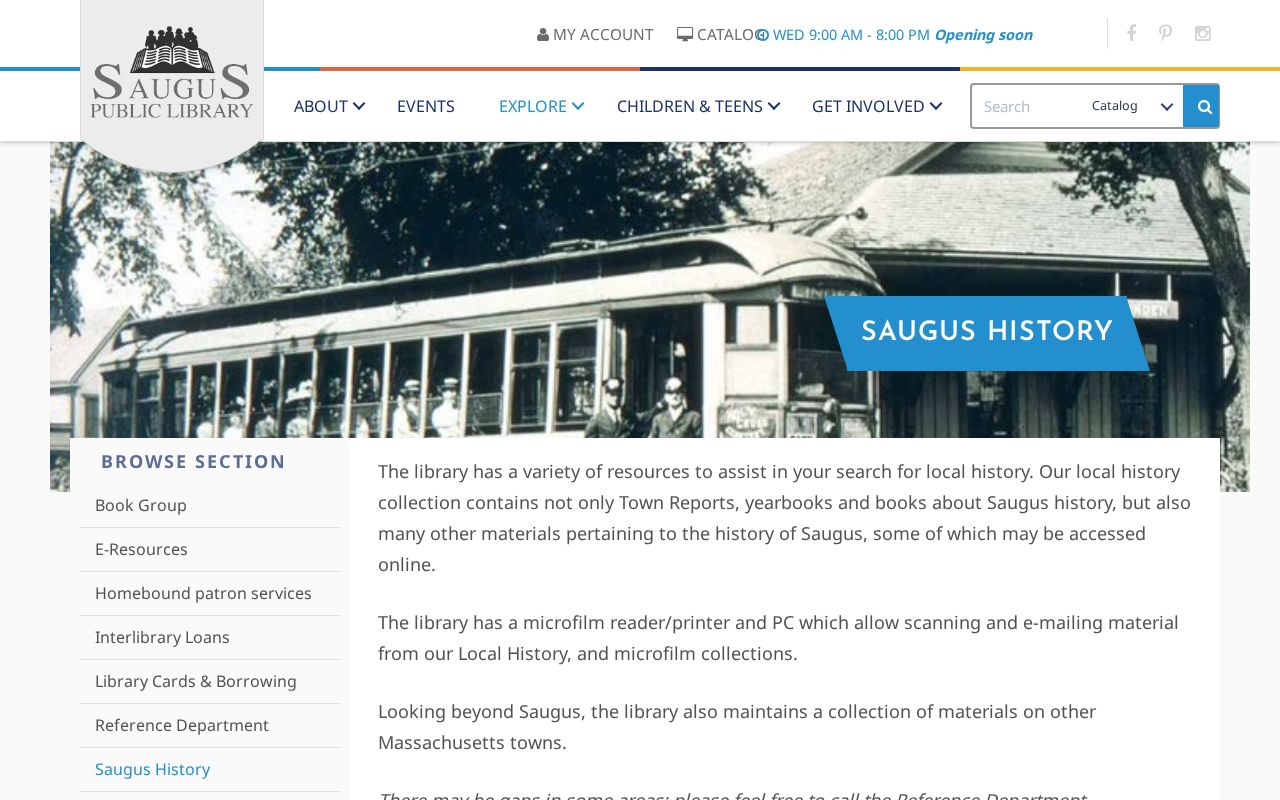
The collection connects city directories with town reports, maps, clippings, and microfilm, so a name or address can be checked against more than one historical source.
Reading Saugus City Directory Entries
One actual local format is available in the digitized 1997 Town of Saugus List of Persons. It is a statutory town list, not a conventional commercial directory, but it makes the street-and-person layout visible. Its street index uses the labels V PC NAME ADDRESS. Person pages can show precinct or number, name, birth year, compressed occupation text, and address. A dot or asterisk can mark a voter in the scan. OCR can distort both symbols and names, so image review is necessary before relying on a line.
| Name as printed | Retain spelling, initials, and punctuation because later indexes may differ. |
|---|---|
| Street or address | Identifies the printed location for that source year, not a current address claim. |
| Spouse or household clue | Some directory styles place a spouse in parentheses; confirm the practice in that volume. |
| Occupation text | A period description or abbreviation that can distinguish same-name entries. |
| Precinct or voter marker | Appears in the 1997 list format and should be described as a mark in that scan. |
- House guide
- An asterisk-marked directory type in the State Library holdings, often useful when research begins with an address rather than a name.
- Criss-cross directory
- A street-ordered directory section that can place listings along an address sequence when that volume includes one.
- Householder index
- An index organized around household or address access; its coverage and labels depend on the individual book.
- Abbreviation key
- The volume’s front-matter explanation of shorthand. Photograph or transcribe it before interpreting a terse entry.
Neither an address line nor a voter mark proves ownership or present occupancy. It is period evidence from one publication. Compare it with a deed, town list, map, or dated notice when the question requires a stronger conclusion.
Saugus Directory House Guides
The asterisks in the State Library inventory are a small but important catalog signal: they identify house guides. Saugus has marked holdings in 1930-1931, 1931, 1932-1933, 1936-1937, 1940-1941, 1942, 1944, 1953-1954, 1955-1956, 1962, 1965-1968, 1970, and 1975. These volumes can be especially useful for a reverse lookup because an address-first arrangement may put a researcher on the right street before a name search begins.
The label does not guarantee that every page contains the same fields or that every building has an entry. Check the front matter and the page layout of the specific issue. When a house guide points to a household, pair its year with the closest available alphabetical volume, List of Persons, or newspaper issue rather than treating one printed line as a complete household roster.
Note: The asterisk identifies a house-guide holding in the State Library inventory, not a promise of uninterrupted street coverage for every Saugus address.
Tracing Saugus City Directory Families
A directory trail works best as a dated series. Start with a name and address in one Saugus volume, then compare the nearest available book on each side. A change in street, spelling, occupation, or spouse notation is a lead to investigate, not a final answer. For a family-history question, use town lists, vital indexes, maps, newspapers, and a census schedule when an appropriate historical census is available through the library’s research channels. Each source adds a different fact.
- Choose a verified directory or list year and capture the exact entry image or page.
- Check a preceding and following available Saugus issue for the same name, spelling variant, and street.
- Use a house guide or street index to see whether the address appears in that publication.
- Pair the dates with town reports, Lists of Persons, and a suitable historical census route.
- Use clippings, vital sources, or probate material only to test a dated lead, keeping each source role separate.
A disappearance may reflect a move, death, omission, a changed address form, or a gap in publication. The Saugus resident lookup route is better for checking a current official record channel; historical volumes remain the evidence for the period they printed.
Saugus Directory Map Clues
A name in a directory is easier to interpret when the place is visible too. The Library of Congress holds a January 1922 Saugus Sanborn map set with 17 images across 16 sheets. It covers Saugus Centre, East Saugus, and Cliftondale. A sheet may show a building footprint, street name, use, and nearby structures. It cannot supply a resident list, but it can help determine whether a directory address refers to a building, a business corridor, or a changed block.
Saugus neighborhood labels carry their own history. Saugus Centre, East Saugus, and Cliftondale are map labels, while a precinct or current parcel grid answers a different geographic question. Keep the map sheet number with the directory page. Doing so helps later researchers understand why a street or number may not match a modern search result.
Saugus Collections Beyond Directories
The directory shelf is part of a larger Saugus record stack. The NOBLE Digital Heritage collection includes yearbook and local-material routes, though its yearbook page notes that 1932 through 1935 are unavailable. Internet Archive hosts Saugus town reports, yearbooks, and lists. The Historical Commission’s Cultural Resources Inventory can add building or demolition context without identifying a continuous line of occupants.
The Saugus Historical Society, founded in 1928, preserves town history, but no official public online holdings catalog was located. The Saugus Iron Works collections add industrial and settlement context through archaeological and archival material. These collections can explain why a place mattered to a family or community institution. They are not a substitute for a dated directory entry or a deed.
Saugus Directory Scan Verification
The digitized 1997 List of Persons is a useful page-image example because it was contributed by Saugus Public Library and has both a street index and person pages. Its 296 pages make it possible to compare what OCR sees with the original scan. The volume is recent enough to require care: use it to understand format and historical research methods, and avoid turning a scanned list into a current-person listing.
A scan of the digitized Saugus list shows why image checking matters when a column mark, punctuation, or abbreviation changes meaning in OCR.

Use the page image, item title, and publication date together, then identify the entry as a statutory town list rather than silently relabeling it as another kind of directory.
Saugus Directory Evidence Limits
A historical directory shows what its editor or public list printed at a particular time. It does not settle deed title, define a parcel boundary, or establish a current residence. A listed person might be an owner, renter, boarder, worker, business contact, or person selected by a statutory list rule. When the source and an address disagree, preserve both forms, record the date, and look for a period map, legal description, or a second dated record.